



Dev to his mother, Dev-aan to his father, DD or Dharam Dev in school, Dev Anand in credit rolls and finally the enduring Dev saab, the man was a legend in his lifetime and left behind a legacy that is sometimes unfairly dwarfed by his persona. As an actor, producer and director, he worked in more than 100 films. He wrote an Autobiography, Romancing with Life, which is a document of a life led without regrets and ranjish, bearing no ill will to anyone and anything, charmed by the beauty of the world and unaffected by its vagaries, almost as if he is an observer in his own world.
I’ve taken it upon myself to go through all his films in order of release, I don’t know how much time it will take me, but many will agree it’s a worthy project. Along the way there will be many digressions and investigations into the cast and crew in Dev saab’s films and life.
The story of Dev Anand launching himself into the cinemascape of Bombay is so delicious that it does deserve a special post toast.
His first film comes to us in 1946. Before we meet him on the sets, let’s dial back 3 years - to 1943 . It was a time of social and political upheaval. WW2 was raging, India was clamouring for freedom and British presence in India was on its last legs. It was also a time of prodigious creative explosion. Performers, artists and writers were breaking new ground, pivoting towards modernism, finding a new voice fuelled by the socio-political turmoil. And Dev Anand was surrounded by remarkable pioneers. They would be responsible for moulding Dev’s ethics and aesthetics.
At 20years old, just out of college, Dev was an urbane young man, well- educated , well dressed and well read. He prided himself on his sophisticated elegance and polished social graces. The Government College Lahore, where he graduated in English Literature from, was counted as an elite institution. With its pro-British inclinations, it was often criticised as ‘an island of English culture in the sea of Oriental Humanity’ (1). However, it was also considered to have impeccable academic standards, with a special focus on grooming in the Arts. ‘All sorts of dramatic activities flourished in the College and were assured of the Principal's patronage.’(2)
'…Lahore was the University; the University was Lahore. The teachers and students were it’s stars and celebrities’, says Uma Anand in her book ‘Chetan Anand- the poetics of Film’
Elder brother Chetan had already been to London as their father wished for him to clear his ICS examinations. Naturally, Dev Anand was eager to follow in the footsteps of his brother, whom he so idolised.
As part of the Empire, an overseas British Education was considered exceptional and was highly sought after not just for its prestige, it was essential for certain professions. ‘Some professions in India were not even open to applicants without a British qualification. For example, between 1853 and 1922, it was only possible to sit the examinations for the Indian Civil Service in Britain. Similarly, to be an advocate in the Indian courts during the Raj (with the right to defend or prosecute criminal cases) required a call to the Bar in Britain.’ (3)
Unfortunately Dev’s father was going through a lean period and couldn’t afford a foreign education for him. He suggested that he get a clerical job in a bank. Luckily for us, Dev felt no need to follow his father’s advice. From his autobiography, one does get a sense that he felt betrayed by his father. It would be a long time before they would reconcile with each other - at the success party of C.I.D.
His father was a well respected and learned lawyer in Gurdaspur, fluent in Urdu, Persian, Hebrew and English. Dev’s mother had passed away of Tuberculosis. As the oldest child at home, he had been her primary caretaker, often taking the bus from Gurdaspur to Amritsar to fetch her medication, until she had to be taken away to a sanatorium, never to return. He writes poignantly of the loss.
‘I was crying in the train now, as I saw the local shopkeeper in Gurdaspur, a friend and well wisher of the family, barge into our compound, announcing to the four young kids who were living all by themselves- for my father was away to be at my mother’s side- that she was no more…and her dead body on the pyre lit into flames in the burning ghat of the dark forest. He uttered the words without any emotion, in a seeming casualness not befitting the cruel moment that sent piercing tongs into our beings’. (4)
1942 saw the beginning of Quit India Movement. WW2 was on and Indian troops continued to be deployed. Dreams of a British Education dashed, Dev Anand applied for the Royal Indian Navy but his application was rejected because of his family’s association with INC. His father was a follower of Gandhi and his eldest brother Manmohan Singh who was a lawyer (also an MA in Sanskrit) was a satyagrahi Gandhian and the secretary of the District Congress Committee in Gurdaspur.
1943 saw the Bengal Famine which killed an estimated 3m people.
Against this social background, in July 1943, a dejected 20 year old Dev Anand, with 30Rs in his pocket, boarded the Frontier Mail to Bombay. The train moved between Mumbai and Peshawar, passing through Lahore and Pindi. It was India’s fastest, fanciest, first Air Conditioned train. A few luxury compartments were kept cool with blocks of ice under the floor, with fans directing cold air into the carriages via vents.Frontier mail was quite a legendary train- luxurious, punctual, the pride of British Indian Railways.
In fact, it was such a part of popular lore that in 1936 a film called Miss Frontier Mail was made. It featured Fearless Nadia running on the roof of the train chasing dacoits. Worried about how such wanton recklessness was going to reflect on British Indian Railways, the producers were asked to add this disclaimer before the film -
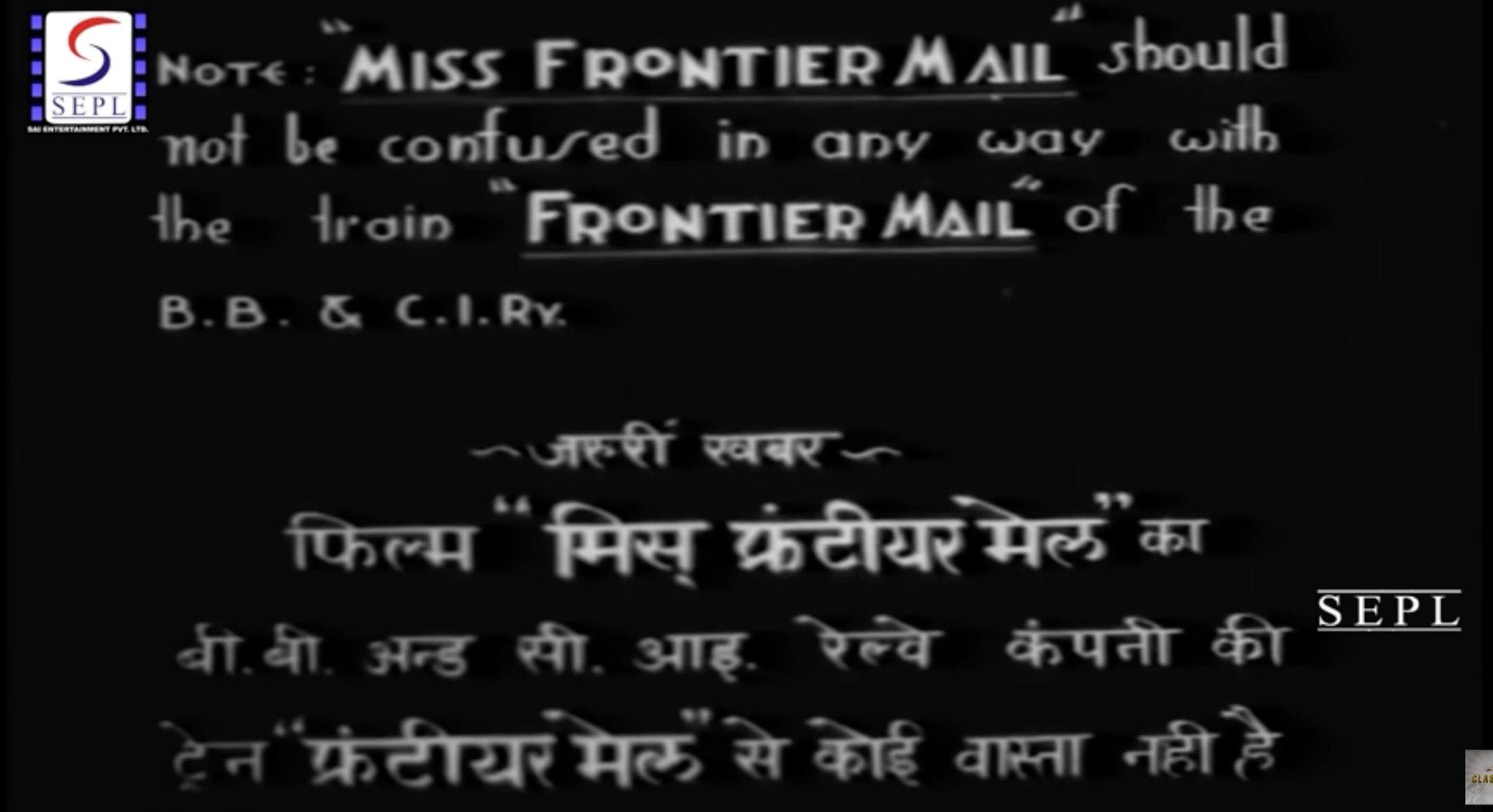
Dialogues like - ‘…woh ladki toofan mail ki tarah aayi, punjab mail ki tarah maar peet karke, frontier mail ban kar hawa ho gayi!’
‘Savita (Fearless Nadia) to humari maani hui frontier mail hai, isliye to bijli ki tarah aa pahunchi!’
‘yeh to mail kee tarah hawa ho gayi… woh bhi frontier mail ki tarah’ - clearly reflect the wide eyed fascination for Frontier Rail and the railways in general.
However, in his budget, Dev Anand could only afford the third class compartment of this legendary train. Chetan Anand, elder brother, was waiting for him at Bombay Central Station.
Chetan, having returned from his Civil Services studies in England, was a teacher at the prestigious Doon School. ‘Erudite, polished, sophisticated’ (5), as Dev describes him, ‘behaved in a manner that many dreamt of emulating’ (6). He was in Bombay to spend his vacation.
It is impossible to draw a fair and complete portrait of Dev Anand’s career without a mention of his brothers- elder brother Chetan and younger Vijay or Goldie. Their collective contribution to Hindi cinema is extraordinary. Chetan was older to Dev by a decade and Goldie, younger by a decade.
Dev Anand says of Chetan Bhaiji - ‘He was a model of everything I admired, handsome, intellectual, fashionable, England-returned…spoke fluent, flawless English’(7). He speaks of the time when he would visit Chetan at Doon School where he was teaching ‘…with the soft hum of conversation … on Byron and Shelley and Keats…He instilled in me a dream to be like him’.(8)
They were staying at Chetan’s friend’s house on Malabar Hill, opposite Baburao Patel’s house where they would watch Sushila Rani (24yrs old then) do her riyaaz every morning. Baburao Patel was a brutal film critic who was the editor and publisher of India’s first trade magazine FilmIndia. Sushila Rani, actress, singer, was his third wife and an accomplished singer. She had trained under Mogubai Kurdikar (Kishori Amonkar’s mother) a giant of Hindustani Classical Vocal music. Besides helping take care of the business, she would write incisive articles on cinema for the magazine. They were a dreaded power couple in Bombay.
Motilal, the film star, and Raja Rao, ‘the famed English novelist’(9) stayed in the same neighbourhood.
In 1938, At 27 years of age, Raja Rao had written Kanthapura - a book by an Indian in English- which had received international attention. Born in Mysore, educated at the Sorbonne in France, he was deeply rooted in Hindu metaphysical traditions, specifically the Hindu Advaita Vedanta philosophy, an interest that he shared with Chetan Anand. Is it too far fetched to imagine that the seed of a character expounding non duality was planted during this time… and bore fruit in the film Guide? R K Narayan (writer of Guide) and Raja Rao were contemporaries. Raja Rao says in his foreword - ‘There is no village in India, that has not a rich…legendary history, of its own. Some god or godlike hero has passed by the village…the Mahatma himself, on one of his many pilgrimages through the country, might have slept in this hut, the low one, by the village gate. In this way…gods mingle with men…’. Doesn’t it sound like this passage has echoes in Guide? It’s perhaps too much of a flight of fancy to suggest that Raja Rao in some way inspired RK Narayan to write this story but can we just take a moment to wonder and marvel at the serendipitous connections that lead to spectacular works of art?
Dev Anand writes of Raja Rao , ‘He was a ladykiller- the very epitome of the tall, dark, handsome type from the Mills and Boon romances. He wore spotless white khadi dhoti kurtas, very stylishly set in a Keralite fashion, with his long hair, always well groomed and parted at the centre, falling over his shoulders. He smelt of a softly fragrant French perfume…’
It’s interesting to note how much emphasis Dev Anand put on elegance of demeanour. It reflected in his choice of roles and styling, on and off screen.
Chetan returned to Doon and Raja Rao offered to host Dev while he looked for a job in Bombay. He introduced Dev to Motilal and K A Abbas, the famous journalist, progressive writer, filmmaker. Abbas had Ismat Chugtai and Shahid Latif as neighbours. They would go on to play a critical role in Dev’s career.
Dev ended up staying at Abbas’s house for 3 weeks, while he went ‘knocking at doors that needed knocking’.(10) Worried about overstaying his welcome he moved out and moved in with another friend, to a chawl opposite KEM hospital in Parel, eating at an Udupi restaurant down the street.
Tired of being penniless and dependant on favours he accepted a job as a clerk in an accountancy firm, where he didn’t last long, since, as he says, ‘maths was never my forte’. Finally, he found a job he liked- that of censoring letters ‘to and from British Army and Personnel’ at the Censorship Dept at Flora Fountain.
He ‘was a hit with the ladies’ crowd at the censor office’,(11) and now living with Chetan bhaiji, who had quit his job at Doon School and was renting a ‘bohemian looking wooden bungalow perched on top of a single rock’ in Pali Hill.
Chetan and his equally remarkable wife Uma’s house, ‘41, Pali Hill’ became a cultural cauldron, a thriving hub of intellectual activity. ‘The place used to be full of restless minds, sharp and high on talent…all without work’. (12) Dev being the one person with a stable salary of 165 Rs. would be lending money to everyone on ‘returnable-when-able-otherwise-forgettable basis’. (13) Poets, singers, musicians, writers would all congregate at 41, Pali Hill. Pandit Ravi Shankar and Ustad Ali Akbar Khan would often be found playing at mehfils for friends.
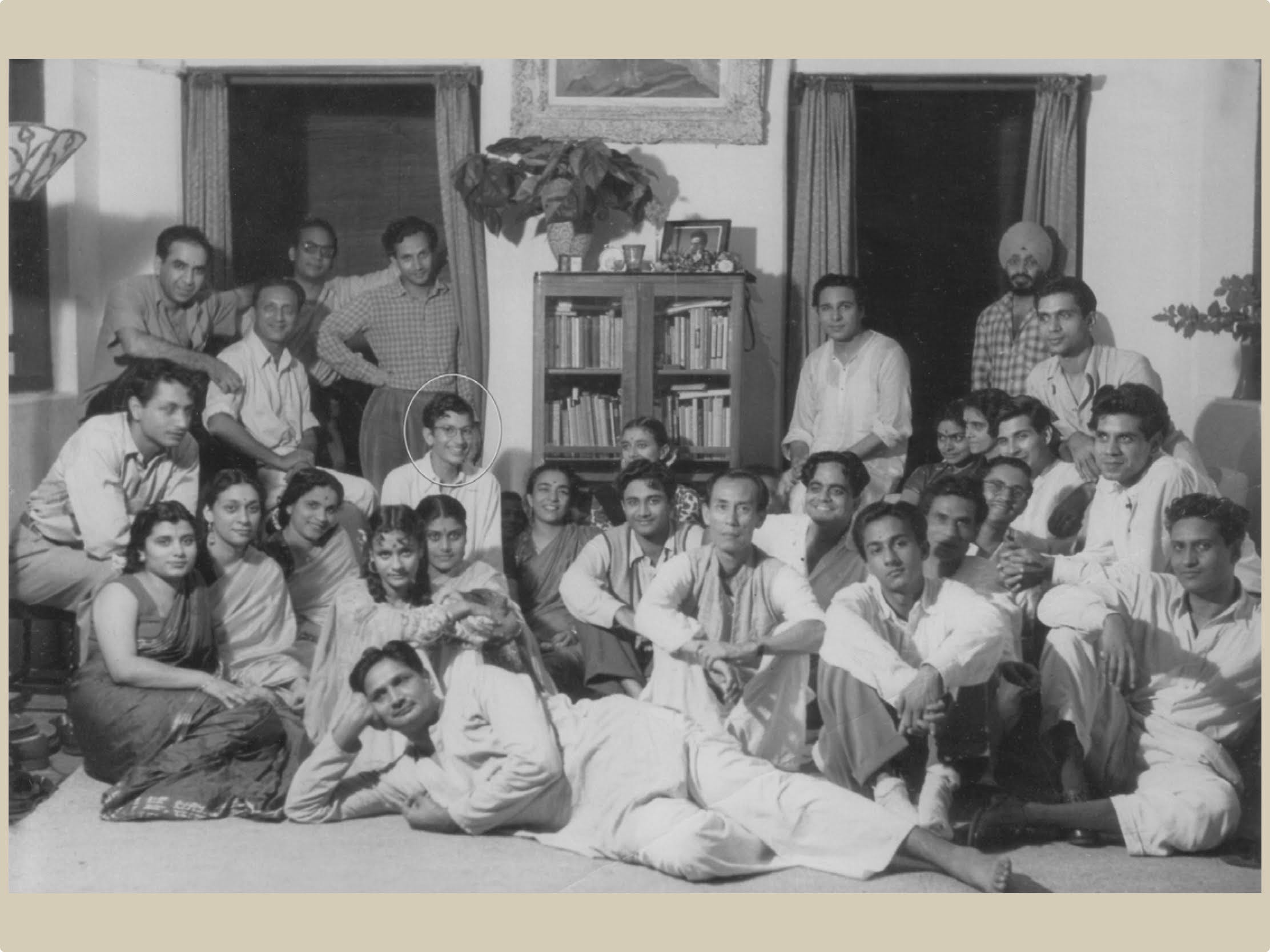
41, Pali Hill
Goldie is marked by a circle. There’s Dev Anand, Goldie Anand, Chetan Anand behind him, Uma Anand, S D Burman, Guru Dutt, Zohra Sehgal, Uzra Butt, Madan Puri, Krishan Dhawan, Manmohan Krishn, Ruma Guhathakurta, D N Madhok and others. - from Vijay Anand’s Biography ‘Goldie’ by Anitaa Padhye
At one point there was Chetan and Uma in one room, Balraj Sahni and his wife Damyanti and 2 kids in one room, Dev Anand and younger brother Vijay (Goldie) Anand in one room and Hamid Butt, Uzra Butt (sister of Zohra Sehgal, cousin of Ismat Chugtai) and family in another room…altogether 12 people. More would pass through in the course of the day- a most fertile ground for ideas, if any.
They were all associated with IPTA (Indian Peoples Theatre Association). Chetan Anand was trying to make Neecha Nagar.
In 1945 this IPTA gang staged a play called Zubeida, written by K A Abbas. Uzra and Chetan were roped in to play the lead and Dev Anand got to play the younger brother of the male lead. I haven’t been able to find the script of Zubeida but I recall reading somewhere that the play was about remarriage of a Muslim woman and Dev Anand played the groom, who enters the theatre on an actual horse with an actual barat. Balraj Sahni directed the play, his first directorial venture and a life altering event for him.
Balraj Sahni says in his biography that even though he doesn’t recall it, at one reading he’s supposed to have told Dev Anand, ‘you can never be an actor’. Yes, he regretted it later. He says Dev Anand was quite hurt by his outburst.
Dev’s search for validation was arduous and fraught but he kept steadfast on his chosen path. He managed to keep his own among the overwhelming number of mavericks he was interacting with.
Chetan Anand managed to find finances for his first film as Director -Neecha Nagar and in 1946 it went on to win the Palm D’Or (Golden Palm) at the first Cannes Festival. Eldest brother Manmohan Singh wrote the lyrics and Ravi Shankar composed the music while Dev Anand patiently waited in the wings.
Even though it brought early glory to Indian Cinema, it didn’t even find a commercial release or distribution in India. Infact, it had a tragic trajectory as the financier was not interested in losing ALL his money on this neo-realist no-song-and-dance drama. He tried to auction it, Chetan approached everyone from Nehru (who loved the film) to Patel in an attempt to get funding to release it.
Long story short, many years later a print of the film was found in Calcutta’s chor bazar selling for pennies to be crafted into cases for ration cards or train passes or similar fashion accessories…and it was spotted by Satyajit Ray’s cameraman, who picked it up and recognized it. That is the print lying with the Film Archives today.
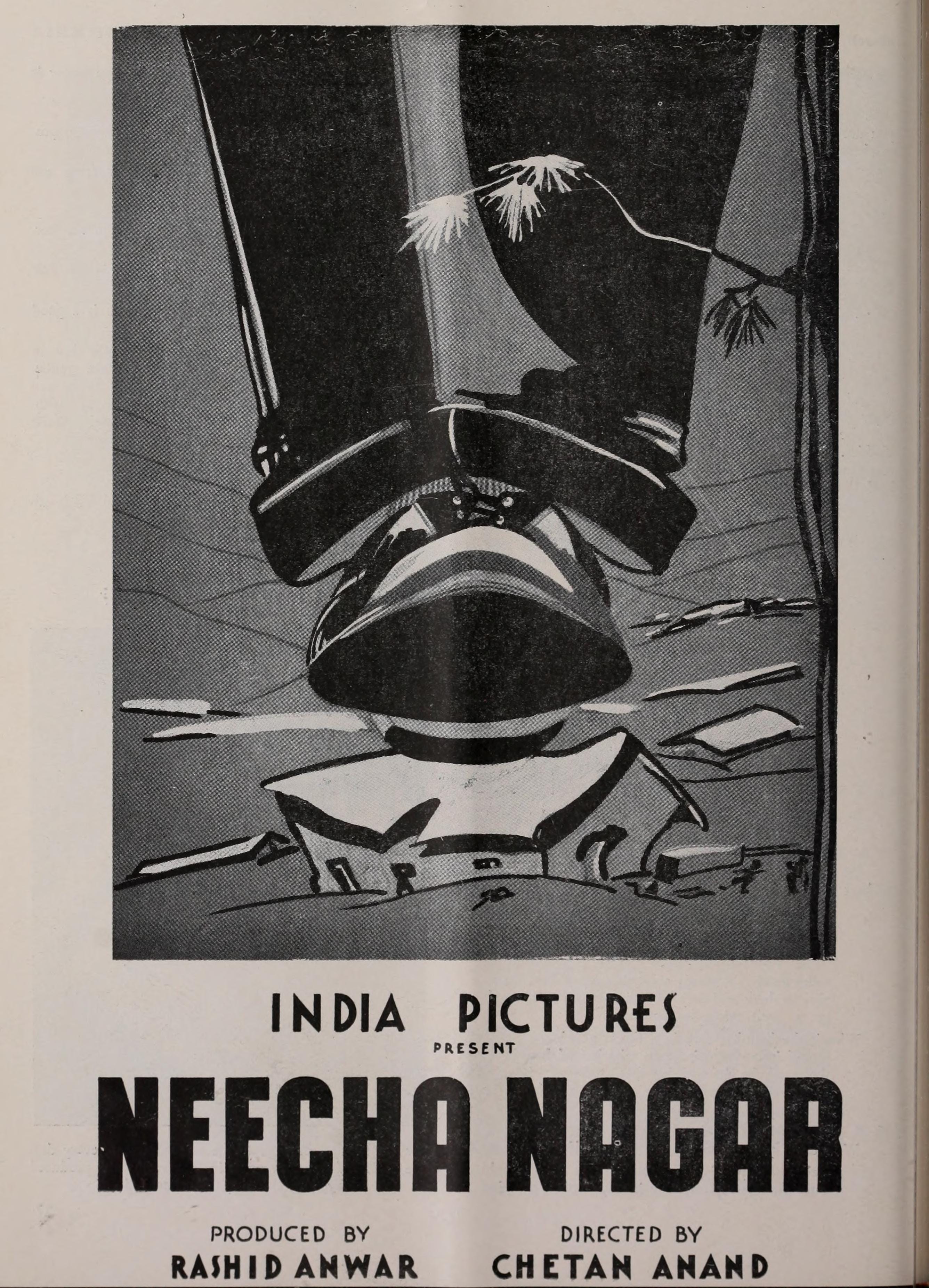
A stunning Expressionist poster for Neecha Nagar (1946) depicting class struggle. (The font for ‘India Pictures’ is inspired from Italian Fascist propaganda posters.)
Another friend from the Pali Hill group, K A Abbas, managed to make another experimental social realist film- Dharti Ke Lal.
Dev Anand waited.
Balraj Sahni in his autobiography relates one telling incident. Nitin Bose had invited everyone associated with the play Zubeida for a meal. When they were at the Bandra station waiting to catch the train to Goregaon, they ran into Nasir Khan (Dilip Kumar’s brother and Ayub Khan’s father). He was friends with Dev Anand. Dev was the youngest in this group, all of whom were elder brother Chetan’s friends. He was shy and timid in their presence so he was happy to drag his friend Nasir along. It’s another story that Nitin Bose ended up casting Nasir in his film ‘Majdoor’ and Dev watched from the sidelines one more time, making his desperation even more acute.
Eventually, Dev quit his job at the Censorship Office. Prabhat Film Company was looking for a new face to launch so he landed at the producer Baburao Pai’s office at Famous Studios and charmed his way into an audition with the director in Pune. He was given a ‘first class return ticket to and from Pune’(13) by another famous train - the Deccan Queen, where he was picked up in ‘a station wagon’ (14). For the audition, he says, ‘I recited…all the ten lines of the only scene given to me in Zubeida…’. The new boy had charmed the director but the gap in his teeth on both sides would need to be filled with fake fillers.
Dev Anand, who was brushed aside as a kid by the luminaries he was surrounded by, was about to fly high. Or not yet. Stardom was going to be a while.
Finally, we are on the sets of Dev Anand’s first film-
Hum Ek Hain (agle episode mein)
Quotes -
(1) (2) (3) https://theconversation.com/indian-students-at-british-universities-is-a-tradition-we-should-cherish-and-protect-70456)
(4-13) Romancing with Life, an autobiography - Dev Anand
Wah! Agle episode par Dev sahab ki tarah hi jhoomte, bal khaate, ja rahe hain hum!
What an interesting read